
What Is Master Data Management (MDM)? A Practical Guide for 2026


What Is Master Data Management (MDM)?
Master data management (MDM) is the discipline of creating and maintaining a single, authoritative, and trusted version of an organisation’s most critical shared data — such as customers, products, suppliers, locations, and employees — across all systems and business units. At its core, MDM eliminates the chaos that results when the same real-world entity (say, “Acme Corp”) is represented inconsistently across your CRM, ERP, data warehouse, and billing platform. Without a functioning MDM program, even the most sophisticated analytics stack will produce reports that contradict each other, erode stakeholder trust, and slow down decisions that should take minutes but take weeks. If you are modernising your data stack in 2026, master data management MDM is not an optional nice-to-have — it is the foundation that makes everything else reliable.
MDM sits at the intersection of data governance, data quality, and data integration. It defines who owns a given data domain, how golden records are created and maintained, and how changes propagate downstream to consuming systems. Think of it as the connective tissue between your operational systems and your analytical platforms.
Why Master Data Management MDM Matters in 2026
In 2026, several converging trends make MDM especially critical:
- AI and ML adoption: Machine learning models trained on fragmented, duplicate, or inconsistent master data produce unreliable outputs. Garbage in, garbage out — and at scale, that is a very expensive problem.
- Regulatory pressure: Regulations such as PIPEDA in Canada, GDPR in Europe, and sector-specific frameworks in financial services and healthcare require organisations to know exactly where customer and patient data lives. That is impossible without MDM.
- Data mesh adoption: As organisations move toward data mesh architectures, domain teams need clearly defined, certified master data entities to build products on top of. MDM provides those certified entities.
- M&A activity: When two companies merge, reconciling two different customer registries or product catalogues is one of the most painful and costly integration challenges. A mature MDM capability dramatically reduces time-to-integration.
DAMA International's Data Management Body of Knowledge (DMBOK2) classifies master data management as one of ten core knowledge areas in enterprise data management — placing it on par with data architecture, data quality, and metadata management in terms of organisational importance. Based on our experience working with mid-size North American companies, organisations that invest in a structured MDM program typically see a measurable reduction in data reconciliation effort within the first two quarters of implementation.
How Does Master Data Management MDM Work? Core Components Explained
MDM is not a single product you install — it is a capability you build, combining technology, process, and people. Understanding its core components helps you scope the right implementation for your organisation's maturity level.
-
1. Master Data Domains
A master data domain is a category of core business entities that are shared across multiple systems. Common domains include:
- Party: Customers, prospects, employees, vendors
- Product: SKUs, product hierarchies, bundles
- Location: Addresses, branches, geographies
- Finance: Chart of accounts, cost centres, legal entities
Each domain requires a designated data steward — a business owner accountable for the accuracy and completeness of that domain's golden records. Without stewardship, MDM devolves into a technology project without a business owner, which is one of the most common reasons MDM initiatives fail.
-
2. Golden Record Creation
The golden record is the single best-version representation of a master data entity, synthesised from multiple source systems. Creating a golden record involves three steps: data ingestion and profiling (understanding what exists across sources), entity resolution (matching and deduplicating records that refer to the same real-world entity), and survivorship (applying rules to determine which attribute values win when sources conflict).
For example, a customer's legal name might exist in four systems with four slightly different spellings. The survivorship rule might specify: "Trust the ERP over the CRM; prefer the most recently updated record when both have the same timestamp." These rules must be documented, version-controlled, and reviewed by the data steward on a regular cadence — ideally enforced through data contracts between producing and consuming systems.
-
3. MDM Implementation Styles
There are four recognised implementation styles, each with different trade-offs:
- Registry style: A central index holds cross-references and match keys, but source systems remain the system of record. Lowest disruption, but golden record is read-only.
- Consolidation style: Source data is pulled into a central hub to create golden records for analytical use. Common in data warehouse contexts.
- Centralised (hub) style: The MDM hub becomes the single system of record. All creates, updates, and deletes go through the hub. Highest data integrity, highest implementation cost.
- Co-existence style: Golden records are created centrally but pushed back to source systems. A practical compromise for large enterprises with established operational systems.
-
4. Data Quality and Matching Rules
Entity resolution is where most MDM projects encounter their first serious technical challenge. Probabilistic matching algorithms score record pairs based on weighted attribute similarity — name, address, phone, email — and classify pairs as matches, non-matches, or candidates for manual review. Tools like Informatica MDM, Reltio, and open-source alternatives such as Splink (built on Apache Spark) provide configurable matching pipelines. Snowflake's documentation describes native support for integrating third-party MDM tools via external functions and Snowpark, enabling in-platform resolution workflows without moving data out of your cloud data warehouse.
MDM Implementation Approaches: A Comparison
Choosing the right MDM approach depends on your organisation's size, existing system landscape, budget, and data maturity. The table below summarises the four core styles across the dimensions most relevant to mid-size companies evaluating a first MDM program:
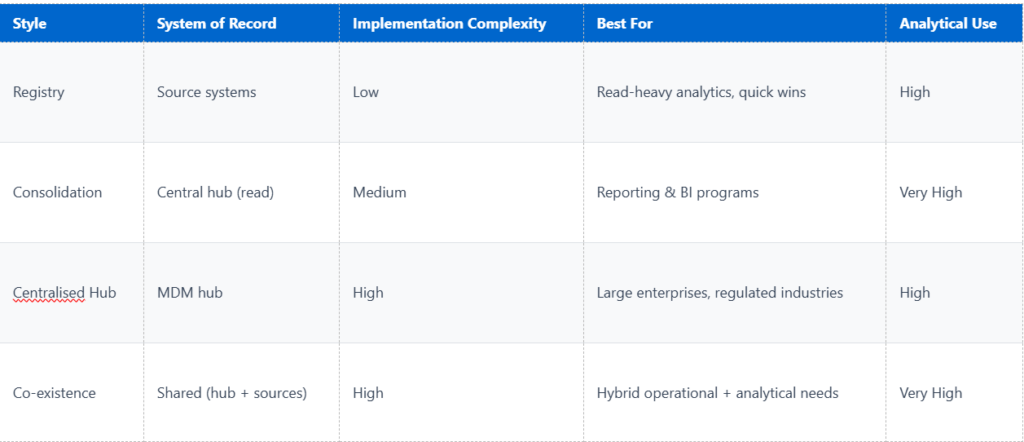
For most mid-size companies embarking on their first MDM initiative, the consolidation style delivers the best return on early investment. It improves analytical trust without requiring a full operational overhaul, and it integrates naturally into a Medallion Architecture on Snowflake — where the gold layer becomes, in effect, your golden record store.
A concrete pattern we use at DataKrypton: in a dbt project targeting Snowflake, a dim_customer_golden model in the gold layer applies survivorship logic in SQL, referencing a ref('stg_crm_customers') and ref('stg_erp_accounts') staging model. A simplified survivorship CTE looks like this:
-
-- models/gold/dim_customer_golden.sql
WITH crm AS (
SELECT customer_id, legal_name, email, updated_at, 'crm' AS source
FROM {{ ref('stg_crm_customers') }}
),
erp AS (
SELECT account_id AS customer_id, legal_name, email, updated_at, 'erp' AS source
FROM {{ ref('stg_erp_accounts') }}
),
unioned AS (
SELECT * FROM crm
UNION ALL
SELECT * FROM erp
),
-- Survivorship: prefer ERP; fall back to CRM; tie-break on recency
ranked AS (
SELECT *,
ROW_NUMBER() OVER (
PARTITION BY customer_id
ORDER BY
CASE source WHEN 'erp' THEN 1 ELSE 2 END,
updated_at DESC
) AS rn
FROM unioned
)
SELECT customer_id, legal_name, email, source AS golden_source, updated_at
FROM ranked
WHERE rn = 1
Common Mistakes and Best Practices in MDM Programs
Based on our experience running MDM engagements across financial services, retail, and healthcare, the same failure patterns appear repeatedly. Recognising them early is often the difference between a successful program and a multi-year sunk cost.
Mistakes to Avoid
- Starting with technology, not domains: Buying an MDM platform before defining your domains, stewardship model, and matching rules virtually guarantees a shelfware outcome. Governance design must precede tooling selection.
- Trying to boil the ocean: Organisations that attempt to MDM every data domain simultaneously almost always stall. Start with the single highest-value domain — typically Customer or Product — demonstrate ROI, then expand.
- Ignoring data quality upstream: MDM cannot compensate for chronically poor source data quality. A parallel data quality framework that profiles and monitors source systems is a prerequisite, not a follow-on.
- No feedback loop to source systems: If golden record corrections never flow back to the originating operational systems, you are treating symptoms rather than causes. A well-designed MDM program includes a data quality feedback mechanism that alerts source system owners when their data consistently fails matching rules.
Best Practices
- Version-control all matching and survivorship rules alongside your dbt models or in a dedicated rules repository.
- Instrument your MDM pipeline with data observability tooling so that match rate, survivorship conflict rate, and golden record freshness are monitored continuously — not just at go-live.
- Align MDM entity identifiers with your data catalog so that lineage from source record to golden record to BI report is fully traceable.
- Treat golden records as a data product with an SLA — define freshness, completeness, and accuracy targets and publish them to consumers, consistent with governance principles for regulated industries
How DataKrypton Helps with Master Data Management MDM
At DataKrypton, we help mid-size North American companies design and implement MDM programs that are pragmatic, scalable, and tightly integrated with their modern data stack. We do not sell MDM software — we design the architecture, implement the pipelines, define the governance model, and enable your internal teams to own and sustain the program long after our engagement ends.
Our typical MDM engagement follows a four-phase approach:
- Discovery and domain prioritisation: We profile your source systems, map data flows, and identify the highest-value domain to address first based on business pain and data readiness.
- Architecture design: We recommend the right MDM style and tooling for your stack — whether that is a native Snowflake consolidation pattern using dbt, an integration with a dedicated MDM platform, or a hybrid approach using the modern data stack components you already have.
- Implementation: We build the matching, survivorship, and golden record pipelines with full test coverage, documentation, and data contract definitions.
- Enablement and handoff: We train your data stewards and data engineers, establish monitoring dashboards in Power BI or your BI tool of choice, and document the governance model so your team can extend the program independently.
If your organisation is experiencing conflicting customer counts across reports, product data that doesn't match between your e-commerce platform and your ERP, or supplier records that no one trusts — those are classic symptoms of an MDM gap that is costing real money and real credibility. Book a free 30-minute consultation with our team and we will help you identify where to start and what a realistic program would look like for your organisation.
About Author:

Debajyoti Kar is the Founder and Principal Data Consultant at DataKrypton AI.
He holds Snowflake SnowPro Core and dbt Developer certifications and has led data engineering and governance
engagements for clients across financial services, retail, and healthcare in Canada and the United States.
A data warehouse is an analytical store optimised for querying historical data across business domains. Master data management MDM is a discipline focused on creating and maintaining a single authoritative version of core shared entities — such as customers and products — that feeds into the data warehouse and other systems. MDM ensures the entities that populate your data warehouse dimensions are consistent, deduplicated, and trusted; the two capabilities complement rather than replace each other.
A focused, single-domain MDM implementation — for example, a Customer golden record consolidation on Snowflake — typically takes between eight and sixteen weeks for a mid-size organisation, depending on source system complexity, data quality baseline, and stakeholder availability. Expanding to additional domains or implementing bi-directional synchronisation with operational systems extends the timeline accordingly. In our experience, the governance design phase is often underestimated and accounts for a third of the total effort.
For many mid-size companies, a consolidation-style MDM program built natively in Snowflake using dbt for survivorship logic and transformation is sufficient to deliver substantial value at a fraction of the cost of a dedicated MDM platform licence. Dedicated platforms such as Informatica MDM or Reltio add value when you need advanced probabilistic matching at very large scale, bi-directional write-back to operational systems, or a workflow engine for stewardship tasks. We typically recommend starting with a native Snowflake and dbt pattern and graduating to a dedicated platform only when you have outgrown it.
A golden record is the single, authoritative, best-version representation of a master data entity — such as a specific customer or product — synthesised from all available source systems. It is created by matching records that refer to the same real-world entity, then applying survivorship rules to select the most trusted attribute values when sources disagree. The golden record becomes the trusted reference that all downstream reports, applications, and analytical models consume.
Master data management MDM is a core operational component of a broader data governance framework. Governance defines the policies, stewardship roles, and accountability structures; MDM is the implementation of those policies applied specifically to critical shared data entities. Without governance, MDM lacks ownership and enforcement; without MDM, governance lacks the operational mechanism to ensure that critical data is actually consistent and trustworthy across the organisation. For a deeper look at the governance layer, see our data governance framework guide.
Our Latest Blog

Stay Ahead with Data Insights
Be the first to know about new frameworks, best practices, and real-world use cases from our data experts.
Subscribe for Data Wisdom
Primary sources and technical references
Use these first-party standards and platform references to validate implementation details and current capabilities.
Continue exploring this topic
- Master Data Management Implementation Plan
- MDM Process Blueprint
- MDM Governance Framework
- Customer Master Data Management
- MDM vs Data Catalog vs Data Governance
- MDM Readiness Checklist
- Customer Master Data Quality Rules
- DAMA Framework Data Governance Guide
- Data Quality Framework Guide
- Data Contracts for Analytics and AI
- Modern Data Platforms and Governance Guide