
Data Contracts for Analytics and AI Workflows
Short answer: A data contract is an agreement between data producers and consumers that defines schema, meaning, quality expectations, ownership, and change rules for a dataset or event stream.
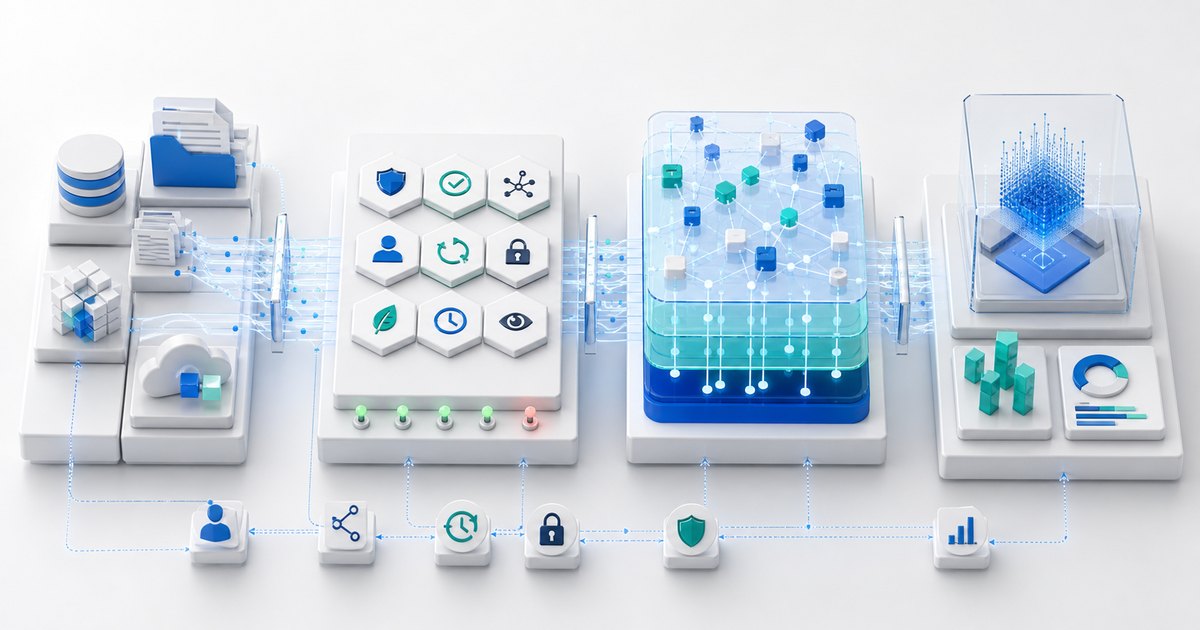
Why Data Contracts Matter
Analytics and AI workflows break when upstream systems change without warning. A renamed field, changed data type, missing value, or altered event meaning can silently corrupt downstream metrics and model context.
- Schema stability.
- Clear ownership.
- Quality expectations.
- Change notification.
- Consumer impact review.
What a Contract Should Include
A contract should be specific enough for engineering teams to validate automatically and clear enough for business teams to understand the meaning of the data product.
- Dataset or event owner.
- Field names and data types.
- Business definitions.
- Required fields and accepted values.
- Freshness and delivery expectations.
- Compatibility and deprecation rules.
Contracts in dbt and Streaming Systems
In dbt, contracts can be represented through model schemas, tests, documentation, and enforced expectations. In streaming systems, contracts often include schema registry rules, event versioning, and producer compatibility checks.
- dbt model contracts.
- Schema tests.
- Source freshness checks.
- Schema registry compatibility.
- Versioned events.
How to Roll Out Contracts
Start with the most important datasets rather than trying to contract everything. Prioritize tables, models, or event streams that feed executive metrics, customer workflows, billing, risk, or AI systems.
- Choose high-impact datasets.
- Name producers and consumers.
- Document current assumptions.
- Add tests and validation.
- Create a change review process.
Related DataKrypton Guides
Five layers of an effective data contract
A schema alone is not a complete contract. It can confirm that a field is an integer while saying nothing about whether the value is gross revenue, net revenue, or a preliminary estimate. Strong contracts combine machine-readable rules with the context a consumer needs to use the data correctly.
Treat the contract as an interface to a data product. The producer remains responsible for the interface, consumers can declare dependencies, and both sides agree how compatibility and incidents will be handled.
- Identity: dataset, event, version, owner, consumers, and purpose.
- Structure: fields, types, nullability, keys, ranges, and accepted values.
- Semantics: business definitions, units, time zones, aggregation rules, and exclusions.
- Service: freshness, completeness, availability, retention, and support expectations.
- Change: compatibility policy, notice period, migration path, approval, and deprecation.
Contract enforcement across batch, streaming, and AI
Enforcement should happen at several points. A producer test catches a breaking schema before deployment. An ingestion check rejects or quarantines malformed records. Transformation tests confirm business invariants. Consumer monitoring detects whether a technically valid change has altered distributions or decision outcomes.
For AI workflows, include fields used to create embeddings, retrieval filters, features, prompts, and automated actions. A renamed field may break a pipeline loudly; a changed definition can produce confident but incorrect output. Semantic review is therefore as important as schema validation.
- Run compatibility and required-field checks in continuous integration.
- Version contracts with code and publish ownership in the catalog.
- Record contract status and processing version in lineage.
- Route failures to a named owner with a consumer-impact view.
How to measure contract adoption
Begin with a small number of high-impact producer-consumer relationships. Select interfaces that have frequent changes, costly incidents, or several downstream users. Baseline failure frequency and recovery effort before enforcement so the program can demonstrate a measurable effect.
A practical scorecard includes the percentage of critical interfaces with an owner, automated compatibility coverage, changes rejected before production, consumers with declared dependencies, contract-related incidents, and median recovery time. These measures keep the program focused on reliability rather than paperwork.
Review contract exceptions with both producers and consumers. A temporary waiver should name the affected interface, reason, compensating control, owner, and expiry condition. This prevents emergency workarounds from becoming permanent undocumented behavior and gives governance teams a concrete queue of residual risk.
Primary sources and technical references
Use these first-party standards and platform references to validate implementation details and current capabilities.
Frequently Asked Questions
Who owns a data contract?
A data contract should have both producer and consumer ownership. Producers own delivery and schema expectations, while consumers confirm that meaning and quality support the business use case.
Do data contracts slow teams down?
Poorly designed contracts can add process, but practical contracts reduce rework by catching breaking changes early and making expectations clear before downstream reports or AI workflows fail.