
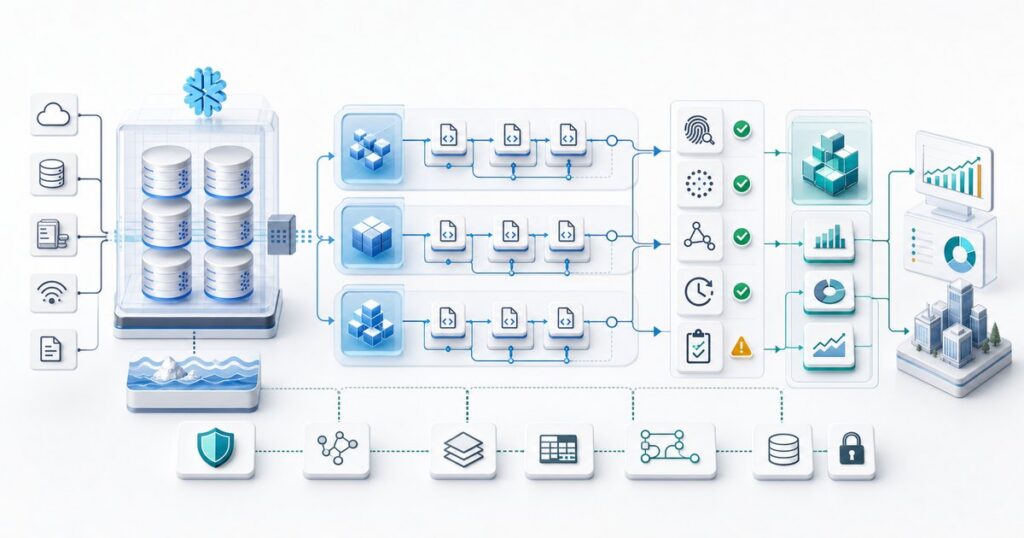
Short answer: Snowflake and dbt create a strong data-quality foundation when Snowflake provides governed storage and workload isolation while dbt turns transformation logic, tests, documentation, lineage, and deployment into version-controlled software. The tools are not the quality strategy by themselves: teams still need clear data contracts, business rules, owners, severity levels, incident workflows, and metrics tied to critical data products.

How Snowflake and dbt Support Data Quality
Snowflake and dbt solve different parts of the delivery problem. Snowflake stores data, executes queries, separates compute workloads, enforces role-based access, and provides platform-level governance capabilities. dbt organizes analytical SQL into modular models, builds dependency lineage, tests assumptions, generates documentation, and connects changes to a code-review and deployment process.
The boundary matters. A not-null test in dbt cannot detect a source extract that never arrived unless freshness or ingestion monitoring exists. A masking policy in Snowflake can protect a sensitive column, but it does not define whether the business meaning of that column is consistent. A mature design assigns each control to the layer where it can detect the issue earliest and where an owner can act.
| Responsibility | Snowflake role | dbt role | Operating owner |
|---|---|---|---|
| Storage and compute | Databases, schemas, warehouses, resource monitoring | Materialization and model selection | Platform engineering |
| Transformation | SQL execution and persisted objects | Modular models, macros, dependencies, deployments | Analytics engineering |
| Quality | Data metric functions, constraints, platform monitoring | Source, unit, generic, and business-rule tests | Data-product owner |
| Governance | Roles, policies, tags, masking, audit history | Descriptions, groups, exposures, contracts, lineage | Governance and security |
| Incident response | Query and load evidence | Failing records, artifacts, changed models | Named support owner |
Design Model Layers for Trust
A dependable dbt project makes the transformation path obvious. Staging models preserve source meaning while applying light standardization. Intermediate models contain reusable joins and business logic. Marts or data products expose stable entities, facts, metrics, and dimensions to analytics consumers. The exact folder names matter less than keeping each layer’s contract clear.
Sources and Staging
Declare source tables, freshness expectations, ownership, and loaded-at fields. Standardize names and types without hiding source-specific behavior.
- Source freshness
- Required identifiers
- Type and timestamp normalization
- Duplicate and late-arrival visibility
Intermediate Logic
Centralize reusable joins, entity resolution, deduplication, and business rules so dashboards do not implement conflicting versions.
- Relationship integrity
- Join-cardinality checks
- Business-rule tests
- Reusable documented logic
Business-Ready Marts
Expose products with stable grains, clear primary keys, approved metrics, understandable descriptions, and accountable owners.
- Unique and non-null keys
- Metric reconciliation
- Accepted dimensions
- Consumer-facing documentation
Exposures and Consumers
Connect models to dashboards, reports, applications, and AI workflows so failures can be prioritized by downstream impact.
- Criticality tier
- Business owner
- Service expectation
- Incident route
Data-Quality Control Matrix
Testing every column produces noise. Prioritize critical data elements and choose controls by failure mode. A field used in billing, regulatory reporting, executive metrics, or automated decisions deserves stronger thresholds and a faster response than an optional exploration field.
| Failure mode | Control | Where to run it | Response |
|---|---|---|---|
| Source did not arrive | Freshness and load-volume threshold | Ingestion and dbt source | Pause dependent publication and notify source owner |
| Primary key duplicated | Unique and not-null tests | Staging and marts | Quarantine or deduplicate with an explicit rule |
| Orphaned relationship | Referential-integrity test | Intermediate and marts | Trace missing parent or late-arriving record |
| Unexpected business value | Accepted-values or custom rule | Staging or business model | Reject, map, or approve the new value |
| Schema breaks a consumer | Model contract and compatibility review | CI and deployment | Block release or version the interface |
| Metric changes unexpectedly | Reconciliation and anomaly threshold | Business-ready mart | Assess source, logic, and business-event causes |
A Minimal dbt Test Example
models:
  - name: fct_orders
    description: One row per completed order.
    columns:
      - name: order_id
        data_tests:
          - unique
          - not_null
      - name: customer_id
        data_tests:
          - relationships:
              arguments:
                to: ref('dim_customers')
                field: customer_id
      - name: order_status
        data_tests:
          - accepted_values:
              arguments:
                values: ['completed', 'returned', 'cancelled']
The useful part is not the YAML syntax. It is the explicit assertion, the owner who decides the allowed behavior, the failing records retained for diagnosis, and the deployment or incident action attached to failure.
Implementation Sequence
- Inventory critical products. List the dashboards, regulatory outputs, operational feeds, and AI workflows that create visible business risk when data is wrong.
- Define grain, keys, and owners. For each product, document what one row represents, the primary identifier, the source authority, and the business and technical owners.
- Establish project conventions. Standardize source declarations, folder layers, naming, materializations, descriptions, contracts, and pull-request expectations.
- Add tests by failure mode. Begin with keys, relationships, freshness, accepted values, and material business rules. Assign severity according to downstream impact.
- Connect tests to deployment. Run appropriate unit and data tests in development and CI, then run production tests at the cadence required by each data product.
- Operate failures as incidents. Route alerts to owners, retain failing records, identify impacted consumers through lineage, and fix recurring causes upstream.
- Review value and noise. Retire tests that create no useful action, strengthen controls around recurring defects, and report quality by business product rather than raw test count.
Keep Quality Controls Cost-Aware
More tests and models are not automatically better. Full-table scans on large facts, repeated logic, unnecessary rebuilds, and mixed workloads can increase cost and delay delivery. Use incremental strategies when their correctness is understood, select changed models and their dependencies in CI, and schedule expensive checks according to risk.
Separate development, transformation, and interactive workloads where contention matters. Review queue time, spill, scan volume, model duration, and warehouse utilization before simply increasing compute. Snowflake provides different query and storage optimization options; each should be tested against the actual workload rather than enabled as a default.
- Run lightweight critical checks on every production build
- Schedule broad reconciliation or anomaly checks at a risk-appropriate cadence
- Use state-aware selection to avoid rebuilding unchanged models where appropriate
- Keep development and production data access and compute boundaries explicit
- Track quality cost per critical data product, not only total warehouse spend
Metrics for a Trusted Snowflake and dbt Platform
- Critical data products meeting freshness and quality service levels
- Coverage of primary keys, relationships, and business-critical fields
- Failed tests by severity, owner, product, and downstream impact
- Mean time to detect, identify the owner, and restore trusted publication
- Recurring defects traced to source capture or transformation logic
- Deployment failure rate and changes rolled back because of quality controls
- Transformation duration, queue time, spill, and compute cost by product
Frequently Asked Questions
Does dbt replace a dedicated data-quality or observability platform?
No. dbt is strong for assertions around sources, transformations, model interfaces, and business logic. Teams may still need ingestion monitoring, cross-platform lineage, anomaly detection, incident management, and observability beyond the dbt execution boundary.
Which dbt tests should a team implement first?
Start with unique and non-null checks on primary keys, relationship checks between important entities, source freshness, accepted values for controlled fields, and custom rules that protect financial, operational, regulatory, or customer-facing outcomes.
Should every dbt test block a production deployment?
No. Severity should match business impact. A breaking contract or duplicate billing identifier may block delivery, while a low-risk descriptive-field threshold may warn an owner without stopping unrelated products.
How does Snowflake contribute to data governance?
Snowflake can enforce roles, object privileges, masking and row-access policies, tags, sharing controls, and audit evidence. Governance also requires business definitions, ownership, approved use, quality expectations, and operating routines outside the platform.
Build a More Trustworthy Snowflake and dbt Delivery System
DataKrypton can assess project structure, model contracts, tests, lineage, warehouse usage, ownership, and incident workflows around your highest-value data products.