
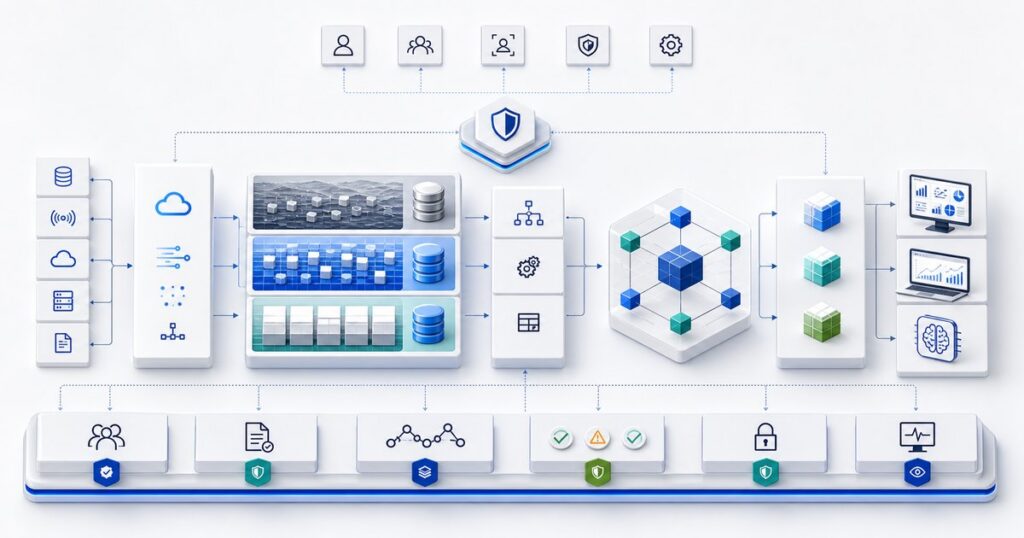
Short answer: A modern data platform is the technical and operational system that turns source data into governed data products for reporting, operations, analytics, and AI. It combines ingestion, durable storage, transformation, orchestration, metadata, quality, security, observability, and serving interfaces. Governance is the control plane across those layers: it defines decision rights, ownership, meaning, acceptable use, quality expectations, and what happens when trusted data fails.

What a Modern Data Platform Must Accomplish
A platform is modern when it improves delivery and control, not merely because it runs in the cloud. It should shorten the path from a source change to a trustworthy data product, make assumptions visible, separate workloads appropriately, preserve traceability, and give owners evidence about quality, cost, access, and usage.
Start with business outcomes. The platform may need to reconcile executive metrics, improve customer operations, support regulatory evidence, enable self-service analysis, reduce pipeline incidents, or provide governed context for AI. Those outcomes determine latency, retention, quality, security, recovery, and operating requirements. Tool selection follows the requirements.
Reliable Delivery
Sources, pipelines, transformations, and serving interfaces have clear service expectations, monitored dependencies, and tested recovery paths.
Shared Meaning
Critical entities and metrics have approved definitions, calculation logic, units, grain, ownership, and lineage to source evidence.
Governed Access
Classification, roles, policies, retention, masking, and audit evidence protect data according to sensitivity and approved use.
Economic Operation
Teams can connect data-product value to storage, compute, tooling, support effort, and consumption instead of treating platform cost as one undifferentiated bill.
Modern Data Platform Reference Architecture
| Layer | Responsibility | Required evidence |
|---|---|---|
| Sources and contracts | Define producer interfaces, change expectations, identity, and delivery | Owner, schema, semantics, freshness, compatibility, escalation |
| Ingestion and orchestration | Move and schedule data reliably across batch, event, and API paths | Run history, retries, checkpoints, dependency state, recovery procedure |
| Raw and historical storage | Preserve replayable source-aligned evidence | Immutable lineage, retention, checksum, partitioning, access policy |
| Transformation | Standardize, integrate, test, and document reusable logic | Versioned code, tests, model lineage, deployment artifact, owner |
| Data products | Publish stable entities, metrics, features, and domain interfaces | Purpose, grain, contract, quality SLO, consumers, support route |
| Serving and consumption | Support BI, applications, APIs, sharing, analytics, and AI | Usage, access evidence, semantic consistency, performance, cost |
| Control plane | Coordinate metadata, governance, quality, security, and observability | Catalog, lineage, policies, incidents, audit trail, capability metrics |
Governance Is the Platform Control Plane
Governance should be embedded in delivery rather than added as a separate approval queue. A source contract, model pull request, quality threshold, access policy, catalog entry, lineage event, and incident record are all governance mechanisms when they make accountability and decision rules executable.
| Governance question | Platform control | Accountable role |
|---|---|---|
| What does this data mean? | Glossary, semantic model, calculation specification, data-product contract | Business data owner |
| Where did it come from? | Technical and business lineage with source references | Technical owner |
| Is it fit for this use? | Quality rules, service levels, certification, issue history | Data-product owner |
| Who may use it? | Classification, purpose, roles, policy enforcement, audit | Security, privacy, and business owner |
| What happens when it fails? | Alert, impact map, owner route, status communication, post-incident action | Operational owner |
| Should it continue to exist? | Usage, cost, duplication, retention, and deprecation review | Portfolio owner |
Design Data Products With Explicit Contracts
A data product is more than a table or dashboard. It is a maintained interface that serves a defined purpose and consumer. It has an owner, documented grain and meaning, a stable access path, quality expectations, lineage, service behavior, and a change process. This approach prevents every consumer from rebuilding source logic and makes platform reliability measurable at the level the business experiences.
- Purpose: the decisions, workflows, or products this data supports
- Interface: table, view, metric, API, event, feature, document set, or semantic endpoint
- Meaning: grain, keys, definitions, units, valid values, and calculation rules
- Reliability: freshness, completeness, availability, latency, and recovery expectations
- Governance: owner, steward, classification, allowed use, retention, and access route
- Change: compatibility, versioning, consumer notice, migration, and deprecation policy
- Economics: usage, support effort, compute, storage, and duplicated alternatives
Implementation Sequence
- Select priority workflows. Choose decisions and operations where unreliable data has visible cost, delay, risk, or AI impact.
- Map products and dependencies. Identify source systems, transformations, metrics, consuming teams, access boundaries, and failure impact.
- Define the target operating model. Name platform, domain, product, governance, security, and support responsibilities with decision rights.
- Establish paved-road patterns. Standardize ingestion, transformation, testing, metadata, deployment, access, and monitoring for common workloads.
- Deliver one end-to-end product. Prove the architecture and controls on a consequential product before multiplying platform services.
- Automate evidence. Capture lineage, tests, policies, deployments, usage, cost, and incidents as part of normal engineering workflows.
- Scale by product and domain. Reuse standards while allowing domain-specific models, service levels, and ownership within clear guardrails.
- Retire the old path. Deprecate duplicate pipelines, metrics, extracts, and dashboards so modernization reduces complexity rather than adding another layer.
Modern Platform and Governance Capability Scorecard
Assess each capability through engagement, repeatable process, and evidence. A policy without an owner is not operating. A pipeline standard without adoption evidence is not a platform capability.
| Capability | Early | Operational | Scaled |
|---|---|---|---|
| Ownership | Known informally | Named for critical products | Decision rights measured across portfolio |
| Quality | Users report defects | Rules and incidents on priority products | Risk-based SLOs and root-cause trends |
| Lineage | Manual diagrams | Automated technical lineage for critical paths | Business impact connected to technical change |
| Metadata | Scattered documentation | Searchable product and term catalog | Metadata drives controls and automation |
| Security | Broad inherited access | Classified products and policy-based roles | Continuous evidence and purpose-aware controls |
| Economics | Platform-level bill | Cost by workload or team | Value, usage, quality, and cost by product |
Metrics Leaders Should Track
- Critical data products meeting freshness, availability, and quality service levels
- Products with named business and technical owners, contracts, and lineage
- Time from source or requirement change to trusted production delivery
- Incidents by product, business impact, recurrence, and mean time to restore trust
- Duplicate metrics, pipelines, extracts, and products retired through modernization
- Active usage, support effort, storage, and compute cost by data product
- Access-policy exceptions and sensitive-data controls with current evidence
Common Modernization Failure Modes
Cloud Migration Without Operating Change
Moving the same undocumented logic and ownership gaps to new infrastructure preserves the failure pattern at a different price point.
Central Governance Bottleneck
A small team cannot approve every definition and access request. Central standards need federated product and domain accountability.
Platform Before Product
Building every possible service before proving a valuable end-to-end product creates complexity without adoption evidence.
No Decommissioning Path
Keeping old and new pipelines, metrics, and dashboards indefinitely makes trust, cost, and support worse instead of better.
Frequently Asked Questions
What is included in a modern data platform?
A modern platform usually includes source contracts, ingestion, storage, transformation, orchestration, metadata, quality, security, observability, and governed serving interfaces for analytics, applications, sharing, and AI. The exact components should follow workload requirements.
What is the difference between a data platform and data governance?
The platform provides technical delivery capabilities. Governance defines the decision rights, ownership, meaning, access, quality expectations, and accountability that make those capabilities produce trustworthy outcomes.
Should governance be centralized or federated?
Most organizations need both. A central function defines enterprise policy, common standards, and assurance, while domain and product owners apply those controls and make decisions close to the data and business workflow.
How should a modernization program begin?
Begin with a small number of consequential workflows, map the data products and dependencies behind them, define the operating model and controls, and deliver one end-to-end product. Use that evidence to refine and scale the platform.
Turn Platform Modernization Into Trusted Data Products
DataKrypton can assess architecture, ownership, quality, metadata, security, observability, delivery patterns, and platform economics around priority business workflows.