
DAMA Framework Explained: The Complete Guide to Data Governance with DAMA-DMBOK


What Is DAMA Framework Data Governance?
The DAMA framework data governance model — formally documented in the DAMA Data Management Body of Knowledge (DMBOK) — is the most widely adopted standard for organising, managing, and governing enterprise data assets. Published by DAMA International, the framework defines data management as a set of 11 interrelated Knowledge Areas (KAs), with Data Governance sitting at the centre as the coordinating discipline. In practical terms, it gives organisations a common vocabulary, a set of roles and responsibilities, and a structured methodology for treating data as a strategic business asset rather than a byproduct of IT operations. If your organisation is beginning a data governance initiative or modernising an existing programme, understanding DAMA-DMBOK is the logical starting point.
Why DAMA Framework Data Governance Matters in 2026
From our consulting work with mid-size North American companies, the pattern is consistent: organisations that attempt to build a modern data stack without a governance foundation quickly accumulate what we call "data debt" — duplicate datasets, undocumented pipelines, untrusted metrics, and compliance gaps that become exponentially more expensive to resolve at scale. The DAMA framework provides the architectural scaffolding to avoid those pitfalls from the start.
It is also worth noting that the rise of Data Mesh architecture and federated data ownership models has made the DAMA-DMBOK vocabulary even more relevant, because cross-domain data sharing requires precisely the kind of formal accountability structures DAMA defines.
Breaking Down the DAMA-DMBOK: The 11 Knowledge Areas
DAMA-DMBOK 2nd Edition organises data management into 11 Knowledge Areas arranged in a wheel diagram, with Data Governance at the hub. Each Knowledge Area has its own goals, activities, roles, and deliverables. Understanding how they interconnect is essential before designing any governance programme.
-
1. Data Governance (The Hub)
Data Governance is the exercise of authority and control over data management practices. It defines the decision rights, accountabilities, and policies that all other Knowledge Areas must operate within. Concretely, this means establishing a Data Governance Council, appointing Data Stewards and Data Owners, ratifying a data policy framework, and creating escalation paths for data-quality disputes. Without this centre, the other ten Knowledge Areas operate as disconnected silos.
-
2. Data Architecture
Data Architecture defines the master blueprints — the conceptual, logical, and physical models that describe how data flows across the enterprise. This is where decisions about Medallion Architecture, data lakehouse patterns, or domain-oriented models are formalised. A well-governed architecture document becomes the contract between business stakeholders and engineering teams.
-
3. Data Modelling and Design
This KA covers the creation and maintenance of data models at every level of abstraction. Consistent naming conventions, entity-relationship diagrams, and canonical data models are the outputs. In our experience, lack of a canonical model is the single most common cause of conflicting KPI definitions across business units.
-
4. Data Storage and Operations
Covers database administration, storage optimisation, backup and recovery, and the operational management of data infrastructure — whether on-premises, on cloud platforms like Snowflake or Azure Synapse, or in hybrid configurations.
-
5. Data Security
Defines how data is classified, access is controlled, and sensitive data is protected. This KA overlaps directly with regulatory compliance and feeds into the specialised governance requirements in financial services, where data lineage and access audit trails are mandatory.
-
6. Data Integration and Interoperability
Governs how data moves between systems — covering ETL, ELT, API-based integration, and event-streaming patterns. If you are evaluating integration approaches, our guide on ELT vs ETL provides a practical comparison relevant to modern cloud architectures.
-
7. Documents and Content
Often overlooked in technology-centric governance programmes, this KA governs unstructured and semi-structured content — documents, emails, contracts — and ensures they are subject to the same lifecycle and retention policies as structured data.
-
8. Reference and Master Data
Master Data Management (MDM) ensures that critical shared entities — customers, products, locations, suppliers — have a single, authoritative, and trusted record. Without MDM, analytics built on top of inconsistent customer identifiers will always produce conflicting results.
-
9. Data Warehousing and Business Intelligence
This KA covers the design, development, and management of analytical environments, from traditional warehouses to modern cloud-native platforms. It connects directly to analytics engineering practices with dbt and the transformation layers that feed reporting and dashboards.
-
10. Metadata Management
Metadata is data about data — lineage, definitions, ownership, classification tags, and usage statistics. A mature metadata management capability is what makes a data catalog genuinely useful rather than a documentation exercise that nobody maintains.
-
11. Data Quality
The final KA defines how data quality is measured, monitored, and improved. DAMA recommends six core dimensions: Completeness, Consistency, Conformity, Accuracy, Integrity, and Timeliness. Our detailed Data Quality Framework guide walks through how to operationalise each dimension in a modern stack.
Implementing DAMA Framework Data Governance: A Practical Comparison
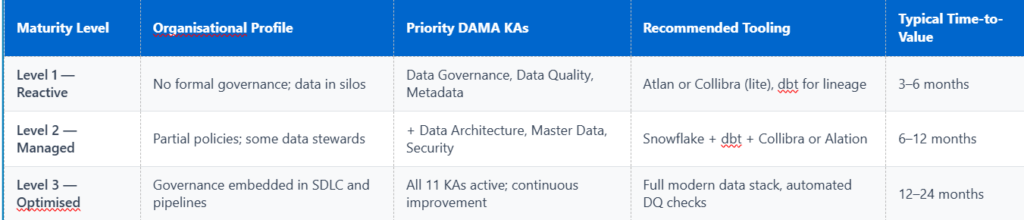
Organisations typically approach DAMA implementation at one of three maturity levels. The table below maps common organisational profiles to the recommended starting scope, tooling tier, and expected time-to-value — based on patterns we observe across engagements.
The dbt model-level schema configuration that enabled this looked similar to the following pattern, where each model carries embedded governance metadata:
-
# models/finance/schema.yml
version: 2models:
- name: fct_revenue
description: "Fact table for recognised revenue. Owner: Finance Data Team."
meta:
owner: finance-data@client.com
sensitivity: confidential
dama_ka: data_warehousing_bi
columns:
- name: revenue_id
description: "Surrogate key — unique per revenue event."
tests:
- unique
- not_null
- name: recognised_date
description: "ISO 8601 date of revenue recognition."
tests:
- not_null
- name: revenue_amount_cad
description: "Revenue in Canadian dollars, post-adjustment."
tests:
- not_null
- dbt_utils.accepted_range:
min_value: 0
This pattern directly operationalises three DAMA KAs simultaneously: Data Quality (the test blocks), Metadata Management (the description and meta fields), and Data Governance (owner attribution and sensitivity classification).
Common Mistakes and Best Practices When Applying DAMA
Even organisations that invest in DAMA-DMBOK training frequently make implementation errors that erode programme value. Based on our experience and observations across the industry, the most common pitfalls are:
- Treating DAMA as an IT project rather than a business programme. DAMA explicitly states that data governance is a business function. If the Data Governance Council does not include C-suite or senior business leadership, policy decisions will lack the authority to be enforced.
- Attempting to implement all 11 Knowledge Areas simultaneously. DAMA-DMBOK itself recommends a phased, risk-prioritised approach. Starting with Data Governance, Data Quality, and Metadata Management gives you the highest return on early investment and builds organisational muscle before expanding scope.
- Confusing data stewardship with data ownership. Data Owners are accountable for a data domain (typically senior business leaders); Data Stewards are responsible for day-to-day data quality within that domain. Conflating the two creates accountability gaps.
- Building a data catalog without a metadata strategy. Tools like Collibra, Alation, or Atlan are enablers, not strategies. Without defined metadata standards — what fields are mandatory, who populates them, how they stay current — a catalog becomes an expensive wiki that nobody trusts. See our data catalog comparison for a detailed breakdown of tooling options.
-
Best practices that consistently deliver results include:
- Define a Data Governance Charter before selecting any tooling.
- Align your DAMA implementation to a recognised maturity model (DAMA-DMBOK includes one; CMMI also offers a data management variant).
- Embed governance checks into your data pipelines as code — not as manual review processes.
- Establish a formal governance framework even if your organisation is mid-size; scaled-down is still structured.
- Measure programme success with quantifiable KPIs: data quality score by domain, time-to-resolution for data incidents, percentage of critical tables with documented owners.
How DataKrypton Helps with DAMA Framework Data Governance
At DataKrypton, we work with mid-size North American organisations that are at an inflection point — typically modernising a legacy data stack onto cloud platforms like Snowflake or Azure, or preparing for regulatory scrutiny that demands demonstrable data lineage and quality controls. Our governance engagements are DAMA-DMBOK aligned by design, which means we are not reinventing the wheel for every client. We bring a repeatable methodology that maps your organisation’s current state across the 11 Knowledge Areas and delivers a prioritised roadmap within the first engagement sprint.
Our technical implementation work pairs naturally with governance design. Whether it is building a dbt and Snowflake-based Medallion Architecture with governance metadata baked into every model layer, or designing a data lakehouse with Iceberg table formats and fine-grained access control, we treat governance as an engineering discipline — not an afterthought.
If your organisation is grappling with untrusted data, undefined ownership, or compliance gaps, we would welcome a conversation.
About Author:

Debajyoti Kar is the Founder and Principal Data Consultant at DataKrypton AI.
He holds Snowflake SnowPro Core and dbt Developer certifications and has led data engineering and governance
engagements for clients across financial services, retail, and healthcare in Canada and the United States.
Primary sources and technical references
Use these first-party standards and platform references to validate implementation details and current capabilities.
FAQ
DAMA stands for Data Management Association International, the global professional organisation for data practitioners. DMBOK stands for Data Management Body of Knowledge, which is DAMA’s flagship publication that defines the 11 Knowledge Areas of enterprise data management. The DAMA-DMBOK 2nd Edition, published in 2017, remains the authoritative reference standard for structuring data governance and data management programmes worldwide.
Unlike vendor-specific frameworks or prescriptive methodologies tied to a particular technology stack, DAMA-DMBOK is tool-agnostic and principle-based. It focuses on what needs to be managed and governed — not which product to buy. Other frameworks like COBIT or ISO 8000 address narrower domains; DAMA covers the full breadth of data management from architecture through quality and security. In most cases, DAMA is used as the overarching framework, with complementary standards applied within specific KAs.
Based on our experience and DAMA’s own guidance, Data Governance should be the first Knowledge Area formalised, because it establishes the decision rights and accountabilities that all other KAs depend upon. In parallel, Metadata Management and Data Quality are typically the highest-ROI areas for early investment because they immediately address the most visible pain points — undocumented data and untrusted metrics. A phased approach over 90-day sprints tends to sustain stakeholder engagement better than a big-bang programme.
Not all 11 Knowledge Areas need to be fully activated simultaneously. Mid-size organisations should adopt DAMA-DMBOK as a reference architecture and implement a subset appropriate to their regulatory environment, data volume, and business complexity. Even a lightweight governance programme that covers Data Governance, Data Quality, and Metadata Management — structured around DAMA principles — provides substantially more value than an ad hoc approach. Our data governance guide for smaller organisations explores how to right-size the framework.
Modern data stack tools operationalise DAMA principles at the engineering layer. dbt, for example, enables Metadata Management through model documentation and lineage tracking, and Data Quality through declarative tests — both of which are DAMA Knowledge Areas. Snowflake’s role-based access control and data sharing capabilities map directly to DAMA’s Data Security and Data Integration KAs. The DAMA framework provides the governance design; tools like dbt and Snowflake provide the technical execution layer. Our guide on dbt and Snowflake implementation shows how these connect in practice.
Before committing to a platform, it is worth understanding where the Microsoft Fabric data lakehouse stands relative to alternatives. The table below reflects our assessment as of mid-2026, based on hands-on implementation experience and publicly available vendor documentation.
