Who Measures Your Data Quality When Your CFO Measures Every Cent?
Data QualityByDebajyotiOctober 15, 2025
Follow
[atlasvoice]
Most organizations review their financial statements every quarter. Teams gather. Budgets are compared. Variances are explained. Audits are run. Every cent is measured — yet few apply the same rigor to data quality.
-
But what about your data? When was the last time your team reviewed data accuracy or completeness with that same discipline?
Data is not magic. It is an asset and it deserves the same attention, measurement, and accountability as cash.
At DataKrypton.ai we believe that trust in numbers begins with trust in data. We help organizations track and report on data health with the same rigor that finance teams apply to budgets and balance sheets.
Why This Matters
Data Quality Drives Decision Quality
Poor business decisions often start with flawed data. In a review of data quality research, scholars note that “decision quality is determined by data quality” that is, even perfect models or dashboards fail if the inputs are bad.
A recent empirical study found that errors, missing values, inconsistencies or mismatches in training or test data directly degrade the performance of machine learning models.
Data Is Complex, Big Data and More
In the modern era of big data, streaming sources, unstructured formats, and rapid change make maintaining high data quality harder than ever. One paper proposes a hierarchical framework of data quality dimensions tailored to big data environments.
Another study highlights that many existing data quality assessment models struggle when faced with unstructured data or evolving schemas.
Governance Unlocks Data Trust
Data governance is not just a buzzword. It is the set of policies, roles, controls, and accountability mechanisms that make data reliable and trustworthy.
Companies with strong governance break down silos define shared data definitions enforce quality rules and assign data stewardship. That leads to consistent, usable data across the enterprise.
When governance is weak each team may have their own version of truth and metrics diverge.
What Good Data Quality Looks Like
To bring the discipline of finance into data we need clear guardrails. Here are some of the key dimensions and practices to aim for.
Core Dimensions of Data Quality
There is no single universally accepted list of dimensions but many frameworks converge. Some core dimensions include:
• Accuracy — are values correct relative to real world or authoritative sources?
• Completeness — are there missing values, or are all required fields present?
• Consistency — do values agree across sources or within the system?
• Timeliness — is data up to date or stale?
• Validity — does data conform to defined formats, types, ranges?
• Uniqueness — no duplicates where there should not be.
One paper extends classical frameworks by adding dimensions such as usefulness, governance, semantics, and quantity to capture more business relevance.
Data Lineage, Audit Trails, and Traceability
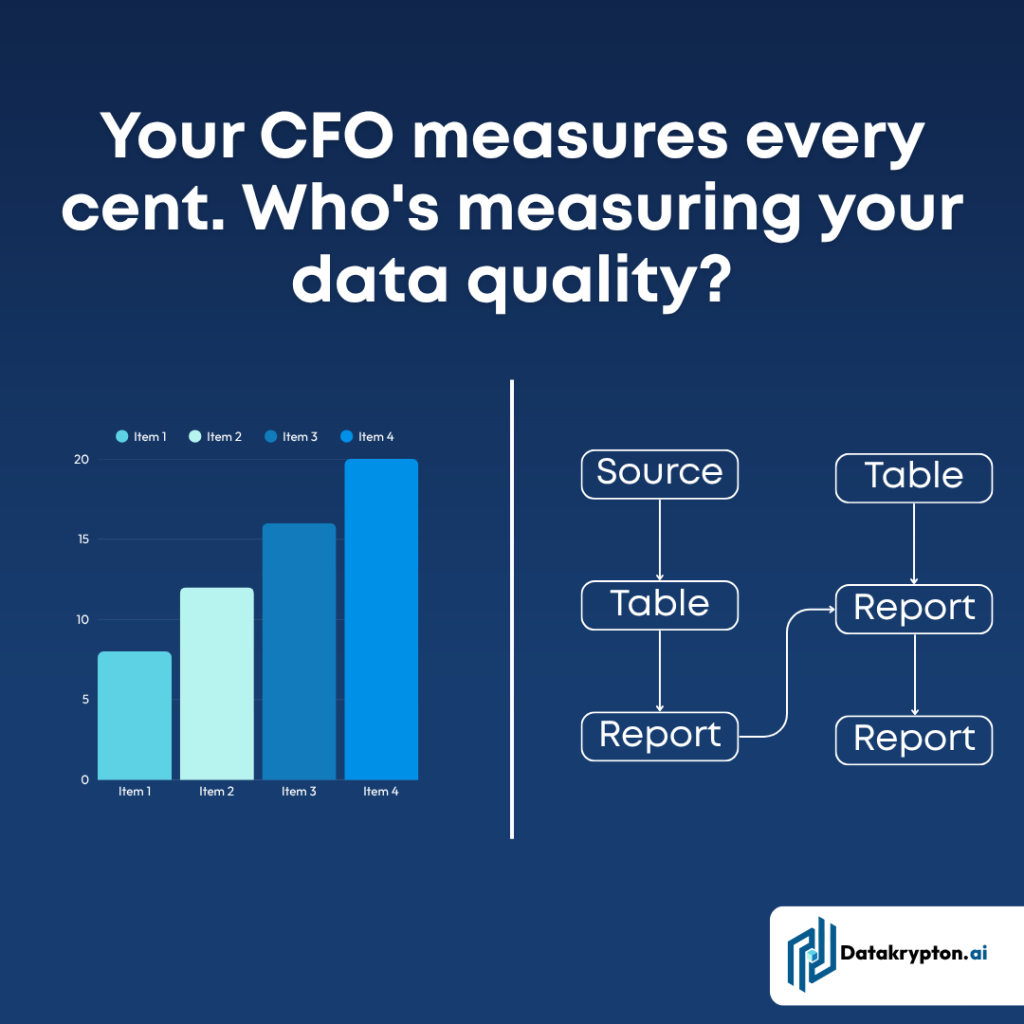
Every data point flowing into dashboards or analysis should be traceable to its origin. Every transformation should be logged. That gives confidence and also helps you diagnose errors when they occur.
Automated Monitoring & Profiling
You do not catch every issue by manual reviews. Organizations use data profiling tools, automated quality checks, alerts, and thresholds to monitor data continuously. In a survey of 667 tools the authors categorize functionality into data profiling, metric measurement, and continuous monitoring.
Data Governance Roles
You need clearly defined roles: data stewards, data owners, data custodians, governance committees. Without accountability no amount of tooling will stick.

How DataKrypton Helps
Here is how we embed the rigor of financial discipline into data practice.
Frameworks and Baselines
We help organizations define their data quality dimensions and set baseline metrics. What is acceptable accuracy? What completeness threshold triggers alert?
Monitoring, Alerts, and Reporting
We build live dashboards showing “data health scores” across systems. We set thresholds, send alerts, and generate periodic reports just like your finance team gets with P&L statements.
Root Cause Analysis & Remediation
When data fails quality checks we assist in tracing back through lineage to root causes a broken pipeline, a missing integration, or a mapping error.
Governance Adoption & Culture
We help teams adopt governance rituals data review cadences, stewardship meetings, data change board reviews so that quality discipline becomes part of the culture, not a one-time project.
FAQ
Q: What is the difference between data quality and data governance?
A: Data quality refers to the characteristics of data (accuracy, completeness, consistency, etc.). Governance is the set of policies, roles, processes, and controls that enable consistent enforcement and accountability of quality across the organization.
Q: How often should you audit data quality?
A: Ideally continuously. But at minimum quarterly reviews (just like financial reviews) provide checkpoints to catch drift, system changes, or new data sources.
Q: What are the biggest challenges in raising data quality?
A: Common obstacles include lack of executive buy-in, inadequate data culture, siloed teams, legacy systems, evolving schemas, and unclear ownership. Research on data engineering highlights the need for holistic strategy strong leadership and cross-functional collaboration.
Q: Can automation reduce human effort in data quality?
A: Yes. Recent work is pushing toward augmented data quality rule definition, where the system helps detect rules automatically and enforce them in warehouses or pipelines.
Q: Does data quality matter for AI and ML?
A: Absolutely. One study showed that polluted training or test data significantly degrade model performance across classification regression and clustering tasks.
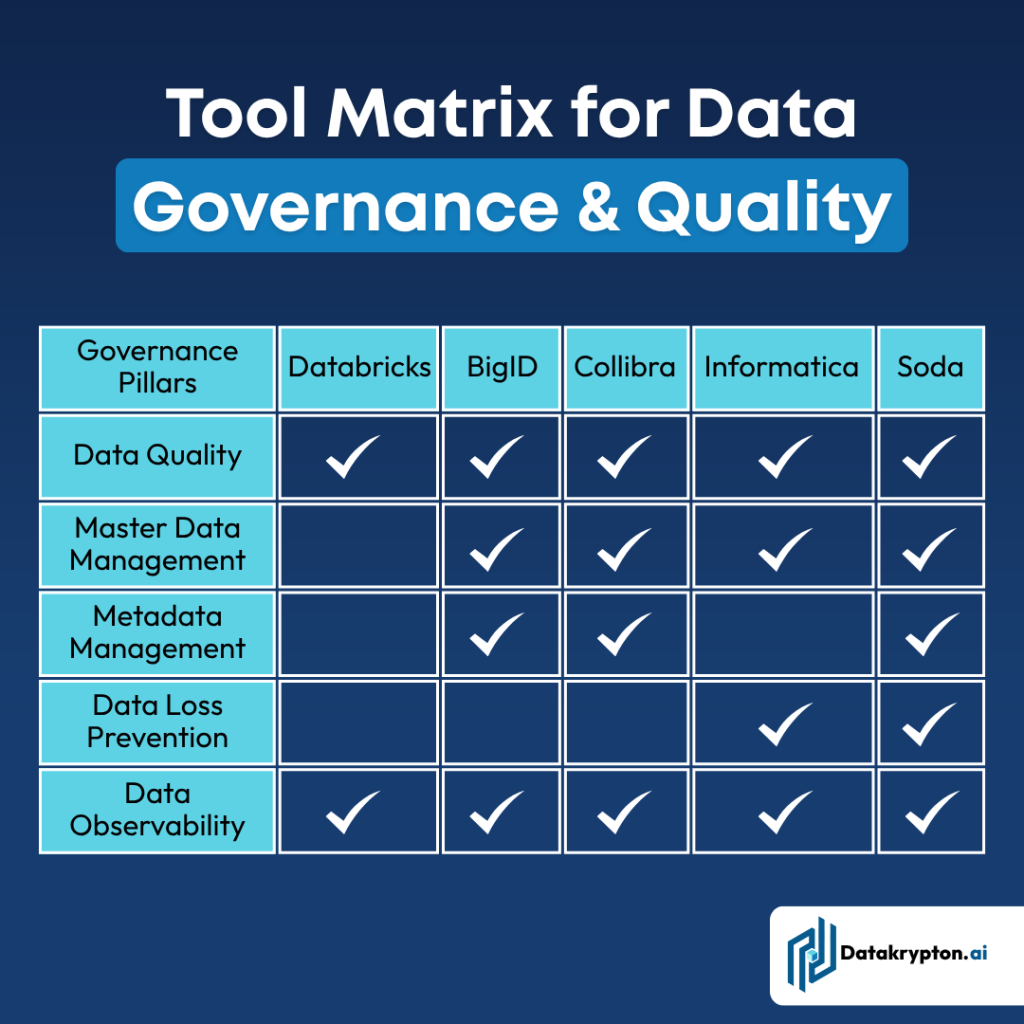
Q: How do you choose data quality tools?
A: Look for tools that support profiling, metrics, monitoring, alerting, and integration. The survey of 667 tools shows that many focus only on parts of this stack pick tools that align with your maturity roadmap.
Your CFO measures every cent. Who is measuring your data quality?
Reliable data deserves discipline. It is not a one-time effort. It is an ongoing investment. Reach out if you want to bring financial rigor to your data operations.
Our Latest Blog

October 17, 2025
Why Data Trust Is Becoming the New KPI for Modern Enterprises

October 16, 2025
Data Observability Is the New Data Security